Mental Wellness, Physical Wellness

Finding my Metaphorical and Physical Rock

From Guest Contributor: Manisha Rajaghatta (Wellness Director, 2017-2018)

Back in middle school, I found myself enrolling in a rock-climbing program through my town’s recreation center. I had never had much exposure to it except in summer camps when I was little, but this slight familiarity was comforting as I explored different after-school activities.

It started with top rope climbing. For those unfamiliar with the sport, there are three major types of climbing when indoor: top rope, bouldering, and lead. Top rope is the one most people are familiar with, where the climber is in a harness and is attached to a rope as they climb up routes on tall walls. The slack is picked up by a “belayer” who also ensures safety and helps them down securely. This is the type of climbing our after-school program focused on and where my love of climbing really started.

As I got older and started climbing with robotics teammates in high school, I was introduced to the world of bouldering.
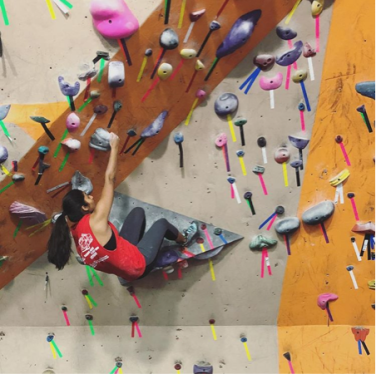
ManishaROCKS.png

This is when you free climb with mats to catch your fall at the bottom of the wall. These routes, like their top rope counterparts, involve a variety of hold types: volumes (like the one my feet are on in the picture above) that project off the wall for added complexity, and “top outs” where you can climb up and over the top of the wall.

While there is also lead climbing where you feed the rope as you climb, my experience has limited me to top rope and boulder climbs. The interesting components of this sport are the two different workouts you can get depending on the type: bouldering is like a sprint, focusing on testing your strength, while top rope climbs are like a marathon, testing your muscular endurance and ability to climb for a long time. This enables the tuning of a workout to target different physical wellness – combining climbing, with cardio and weight training, allows for a comprehensive workout as rock climbing is truly a whole-body workout as legs, arms, back and abs are all used when approaching a route.

This physical component has made rock climbing a passion that’s grown over the years in addition to sports and other activities I’ve done. My athleticism is worked on overall throughout the week depending on my workouts and in turn, so is my brain. Rock climbing is very much a mental sport as well as physical since your biggest enemy can be your motivation and willpower. By training my brain to keep going through a climb or moving on a route, I have been able to work on my focus and internal drive in all aspects of my life. If you don’t believe in yourself, you’ll never get through the route, and further, you won’t be able to climb at higher levels and try moves that are super fun. Especially on the top rope climbs, the combined test of motivation and endurance really pushes me to be able to achieve my best, both in the sport and in life. It’s a stress reliever in so many ways whenever I get to the rock wall and I find it as a great escape when I need to step back from anything and revisit it with fresh mind and body.

This is actually a part of the sport that has always resonated with me, no matter what is going on in my life. Regardless of the challenges, physical and mental, that life throws at me, rock climbing is always there for me to blow off steam and push myself to achieve more and do better. I’ve left rock climbing temporarily a few times in my life because of time/life choices or injuries.

The first time was from middle school to high school as the transition had me pursuing other activities and in a way, forgetting about rock climbing during my weekly schedule. The second time was freshman year of college, again because of time commitments. The third time was actually for a super short time this past year as a result of a rock climbing injury. Each time, I found myself rediscovering the sport and finding how it fit into my life in a new way each time. The first time was a social activity to do with friends, the second time was a way to blow off stress while getting back into working out, and the third time was a way to maintain my love for the sport as a hobby but also as a competitive sport.

The key takeaway from this has been that no matter what has been going on in my life, rock climbing has been my metaphorical and physical rock to keep me grounded. Each time I’ve drifted from it, I’ve found my way back because it’s something that makes me feel physically and mentally complete. Without it regularly in my life, I find myself itching to get back to the rock wall and trying a new climb. It’s a way to keep me mentally and physically well and if I hadn’t found something like this, that I could rely on no matter what my life throws at me, I’d be very unbalanced.

Mental Wellness

how we ACT affects how we feel

From Guest Contributor: Maddie Pelchat

I first asked my mom if I could go to therapy during a stressful time in my life, the end of high school, when I was being told that my successes and failures in school and college applications would affect the rest of my life. The weight of this pressure along with undiagnosed depression slowly broke me down over time until I realized that I was not able to battle this alone. I started therapy, and these initial cognitive-behavioral sessions helped me to break down irrational thoughts and allowed me to develop a healthier way of thinking. Although a lot of the emotions I was feeling were due to events out of my control, I left each session with a better perspective on my life and it allowed me to flourish and be proud of myself.

After leaving my hometown for college, I decided that I had the mental skills to manage my stress, and put therapy on hold. This past year, after battling a rough seasonal depression worsened by a difficult co-op experience, I was feeling the pressure begin to build again. I was anxious about maintaining my GPA, and adding to my resume before my next co-op cycle. I felt that I wasn’t good enough and was constantly comparing myself to other women in engineering. I finally decided that enough was enough and I enrolled in the Drexel Counseling Center’s ACT workshop.

This workshop is one hour a week over three weeks, and I enrolled at the beginning of the term so I wouldn’t feel overwhelmed taking time away from studying! This workshop was like group therapy, and there were a few other people attending each week. I didn’t have to share if I didn’t want to, and even if I did the workshop felt like a no-judgement zone, so I felt comfortable despite it being my first therapy session that wasn’t one-on-one. First, we discussed things in our lives that made us feel positively and things that caused more negative emotions. For example, spending time with my family makes me feel loved whereas illnesses in my family scares me and makes me worried about the future. Taking time for myself makes me happy whereas GPA monitoring makes me anxious. We discussed ways to move towards the positive feelings rather than away from the negative ones. Running away from our problems doesn’t make them disappear, and this was a lesson that was extremely important for me to learn. For example, if classes were stressing me out, it wouldn’t help to ignore my work, but rather I could look forward to a family dinner or a night out with friends after studying, to reduce the focus and stress surrounding my work.

This workshop put my core values into perspective, allowing me to make the best decisions for my life and for my mental health. I learned not to compare myself to others but rather to focus on my own happiness and personal goals. The workshop also introduced me to mindfulness, which I have now incorporated into my life in a daily yoga practice. It is important to take time each day to remove oneself from the chaos of school or work and to focus on simply being. I truly believe that this workshop changed my way of thinking for the best and I hope that I continue to uphold what I’ve learned through ACT when making decisions and thinking about my future. I feel much more calm and satisfied with my life and I recommend taking time for therapy or mindfulness practice to anyone feeling stressed or unsatisfied in their life.

For those that are interested, SWE is holding an event with Dr. Gotlib from the Drexel Counseling Center on Psychological Flexibility on Monday, January 28th from 7-8pm in the Hill Conference Room. Please come and join us!!

For more information on workshops through the Drexel Counseling Center, please visit this page.

Physical Wellness

So Much More Than Just the Distance

From Guest Contributor: Isabel Wingert

You often hear the saying “you get out of things what you put into them”. It’s very true. Training and running a marathon is about so much more than just the distance.

Running a marathon had always been something in the back of my head for a long time. The first exposure I had to the feat was in July 2004, when I was in California with my father. I overheard him and my aunt (his sister) deciding over the phone that they were going to run the Marine Corps Marathon in Washington, DC in the fall.

“Huh, 26.2 miles.” I heard my dad remark to my aunt on the phone.

“Daddy, that’s a lot,” I remember saying afterwards.

“Yeah, but it’s amazing,” he clarified to me, then laughed with my aunt. The next morning, he laced up his shoes, and started his training, even on vacation and with the hot California heat. His confidence and watching him run had a small impact on me. When the race came, eight year old me really made sure she was there. And I’m happy it was that way — I remember the spirit at the race among everyone there was indelible. I remember the brisk fall day hanging with my Bubby and Grammom (my grandparents) and walking around the ‘Washington Omelet’ (aka Washington Monument), and the spectators lining up cheering on strangers, there with no agenda or asking for anything to be gained.

I continued jogs regularly growing up through middle school, high school, and through Drexel. In 2017 as a pre-junior, I decided to run the Philadelphia Marathon. As an engineering student, I would go for small jogs on the Schuylkill River Trail, passing the Art Museum, but I had never covered a crazy distance like 26.2 miles. The decision came during a rather rough patch in my life, and I wanted to prove something to myself too, even if it was something insane as running 26.2 miles.

Most of the runs in my training were spent alone, even if it was just a small 30 minute run. It took a bit of getting used to – I was a competitive swimmer growing up, which was very much a team sport. I wasn’t quite used to having myself as my own competition. That made me look at the training as ‘Can I cover X amount of distance in Y amount of time?’ I remember later on, as soon as I started to look at it as if any run was a run to help, it also made me closer to realizing my goal. I also had long runs which I remember I would have to get up at the crack of dawn for to fit into the day. Fitting runs in was sometimes rough, but soon all the running I was doing became very rewarding — something to bust engineering and personal related stressors off. If I had time to worry, then I could run. Balancing something like training for a marathon can be difficult with an engineering curriculum, but the important thing to remember is that work is never wasted. I remember applying the same diligence I learned from the training to my schoolwork. A little of a task like emailing a TA for help is as good as running for thirty minutes. It added up. What I had done, the miles I had covered looking behind me, soon pretty much took over the 26.2 mile race day in my eyes.

Almost all the support I got from friends and family along the way was verbal encouragement. I did have a running buddy in the beginning who was also training, but we drifted apart after he returned home to Harrisburg for his co-op in the Fall of 2017. I tried to not let the thought of being alone in person during the race bother me so much. It was also great that there were apps for my family and friends to track me and send me cheers in the race.

Race day then came on November 19th, 2017. The sun was not even up by the time I got to the start line, the same place where I would finish 4 hours later. Corrals started forming. Even though the Benjamin Franklin Parkway was completely filled to the brim with all of us, I remember the feeling of being alone started to creep in again. It was all a whir when I started to run the race. Honestly, thoughts in my head swirled way too fast for me to decipher, but “What the hell” would sum it up. About two minutes later, closer into Center City, I was able to pinpoint a much needed familiar scream from my younger, eight year old brother, who was holding up a giant sign with my name in giant purple letters. One that I had never seen before. The surprise was a huge boost for me, seeing him jump up and down with a smile, with my brother. He was SO happy and excited to see me do this race. I kept going.

isabel's post

The run was very scenic. I ran through Center City and Old City. The first 15 miles were great. Soon, things started to dawn on me again as the ran proceeded onto Kelly Drive along the river. One thing that didn’t help was that it was a very windy day. The wind was certainly not on anyone’s side. I remember seeing fellow runners close to giving up because we had to fight through it and some of them were in pain from the wind. At least the 20 mile turnaround on Main Street in Manayunk was huge for a lot of people. It also started to feel never-ending again even with all the spectators from Manayunk dropping by.

The last 6 miles back on Kelly Drive again towards the Parkway was the longest hour of my life. Not that many spectators were as lined up along Kelly Drive as other spots were. I was starting to hit the infamous wall. I decided to call my dad at about mile 23, when my phone was about to die. If I wanted to hear from anyone, it was him. I remember being a bit weepy and in pain to him, but he reminded me again “This is amazing”. And he told me he was proud of me. The wall still did hurt, but 3 miles looked closer to being like a small run again. I powered through. I didn’t meet my goal time (I missed by 10 minutes), but I was still proud of myself. Sometimes powering through is still an incredible thing to do.

As I hit closer to Boathouse Row, I then remembered D.C. There seemed to be a wave of camaraderie that I remember feeling from 2004 amongst everyone as I saw more spectators. I remember a runner who had stayed within the same pace of me along Kelly Drive turned and smiled at me. In that present moment, I definitely felt that everyone there was finishing strong from the event. The race was not all about competition. The finish line was overwhelming as I crossed it. It was strange — the long haul was done, and I remember feeling very light on my feet again. I was gasping and laughing from that final dash and from seeing my little brother chase me down through the parkway, and from thinking about how I had to think about lugging myself through this huge and spirited crowd to navigate to him and my family. It didn’t matter though — everyone there had got something from the race.

I came home and stayed home for the entire week, doing all my homework online through communication with my professors, and I remember partially being stressed from that, but hey, I freaking ran 26.2 miles and I worked towards it too. I definitely feel nothing discounts something like all the work I had showed myself that I was capable of doing.

On race day, I powered through with everyone, and I little-by-little achieved something huge to share. That’s the one thing that makes me happy when look back to the training and race day.

My dad is now back to running, and we are planning on doing the Broad Street Run and a Steelman Triathlon together over the summer. One of my best friends also recently told me he wants to try Broad Street with me as well. I would be so excited if the three of us get to run Broad Street together. Both my father and my friend are two of my biggest supporters, and I can only hope that I can give the support they deserve as well. I can only hope that they learn something for themselves like I did. I really hope something unique comes to them if we can race together.

If anyone really wants to run a race like a marathon, I definitely recommend it. Running a race is such an individual experience that one can fully own. Yet it can be shared. It’s so much more than a distance.

Meal Prep & Nutrition

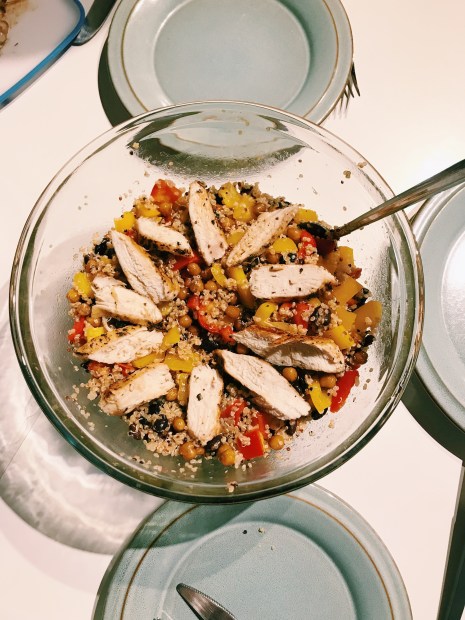
Smoky Quinoa and Black Bean Salad (Vegan)

This is one of my favorite meal prep recipes! I make it in bulk and then portion it out for either lunches or dinners during the week. The original recipe is from budgetbytes.com, but the below recipe includes some of my alterations. (Quick plug: Budget Bytes is a great website. I like it because you can change the serving size and it will tell you how much each ingredient costs per serving. It is great for us college students who are on a budget!) This recipe says that it makes 4 servings, although I typically find that it makes a bit more than that.

Note: I often also make chicken with this recipe that I sometimes cut up to toss in the salad or I eat it on the side. I normally season the chicken with oregano, thyme, rosemary, salt, and pepper. This makes the recipe no longer vegan, but delicious nonetheless. 

INGREDIENTS

  • 1 cup uncooked quinoa
  • 1/4 cup olive oil
  • 1 Tbsp apple cider vinegar
  • 1/2 tsp smoked paprika
  • 1/4 tsp cumin
  • 1/8 tsp garlic powder
  • 1/2 tsp salt
  • Freshly cracked pepper
  • 15 oz can black beans
  • 15 oz can of garbanzo beans
  • 2 bell peppers (preferable red, yellow, or orange)
  • 2 green onions (I have never used these in this recipe)

DIRECTIONS

  1. Use a wire mesh sieve to rinse the quinoa. Drain away the excess water and place the rinsed quinoa in a sauce pot.
  2. Add 1.75 cups water to the sauce pot with the quinoa, place a lid on top, and bring it up to a boil over high heat. Once it reaches a boil, turn the heat down to low and let it simmer for 15 minutes. After 15 minutes, turn the heat off and let it rest for 5 minutes, without removing the lid. Finally, fluff with a fork and allow the quinoa to cool. You can place the quinoa in the refrigerator for faster cooling.
  3. While the quinoa is cooking, rinse and drain the garbanzo beans. Toss them in salt, pepper, and olive oil and toast them on a baking sheet in the oven. You can keep them in until they reach your desired crunchiness, but don’t dry them out entirely. Toss them periodically for even cooking.
  4. While the quinoa is cooking, prepare the dressing. In a small bowl whisk together the olive oil, vinegar, smoked paprika, cumin, garlic powder, salt, and freshly cracked pepper. Set the dressing aside.
  5. Rinse and drain the black beans. Dice the bell peppers, and slice the green onions.
  6. Combine the beans (both types), bell peppers, green onions, and cooled quinoa in a large bowl. Pour the dressing over top, and stir until everything is evenly mixed and coated in dressing. Taste and adjust the salt if needed. Serve immediately or refrigerate until ready to eat. Make sure to stir the salad well before serving.

5FF482F7-B0A4-46BE-927F-FEC9284B9FF5.JPG


Mental Wellness, Physical Wellness

“I feel like I haven’t slept.”

I ordered a Fitbit after wanting to keep track of my activity for quite some time. With co-op coming to a close, I thought “girl treat yo self” and pre-ordered the newest model, the Charge 3. Although it has many great features, the one I became obsessed with was the sleep tracking. Unfortunately, my tracking started right as Drexel’s midterms season rolled around, so I was more than optimistic when I set my sleep goal to 8 hours per night. I also set a sleep schedule goal, where I aimed to sleep between 11:30pm and 7:30am. My Fitbit was set to remind me every night at 11:15pm to start getting ready for bed. You can imagine how cruel it felt when my wrist would buzz reminding me to wind down for bed soon when I was still over a half mile away from my bed, in the library with hours of studying still ahead of me. Each night I thought that it would be alright and when I finally did get into bed I would pass out and get some quality deep sleep. Apparently I was wrong.

To my surprise, every morning my Fitbit would tell me that I was spending significant portions of the night awake or restless. I couldn’t understand how I was possibly so restless if I was exhausted. After seeing this, I was determined to improve the quality and quantity of my sleep.

Here are some tips for getting better sleep:

  1. Track yourself! You don’t need a fancy watch or app to do it. (If you are interested in sleep apps, you can check out this article for some good ones!) You can keep a post it note by your bed and jot down what time you go to bed and wake up. You can calculate your weekly sleep average (c’mon engineers, it’s simple math!) and look for weekly patterns. By writing it down or tracking your sleep in some capacity, you will learn more about your sleep habits and may feel more motivated to stick to your schedule.
  2. Don’t let the last thing you look at before bed be a screen! During my sophomore year, I would read a little bit every night before bed even if it was just a page. I felt so much better and I found that falling asleep was actually easier. Plus it helps you to slowly tackle that reading list that you never seem to have time for. If you have to look at a screen late at night, make sure you set it up to be in night mode where the colors are adjusted to be easier on your eyes.
  3. Put your phone on do not disturb! Don’t let late night notifications keep you awake. You can adjust your settings so your favorites will still be able to call you if there is an emergency. This term, I am aiming to not look at my phone for the rest of the night once I put it on do not disturb. Most notifications can wait until morning anyways!
  4. Wear a sleeping mask or ear plugs! If the noises of West Philly are keeping you up, try some ear plugs. I know there are some nights when I feel like all I hear as I am falling asleep is “bus is turning”. If your shades are insufficient or your roommate likes to keep lights on, invest in a sleeping mask. They are much cheaper than blackout shades and it is portable so you can take it with you on trips.
  5. Drink decaffeinated tea! Drinking tea as you wind down your nightly activities will help you to relax. Plus it is delicious! For a list of some of the best night-time teas and why they are beneficial, check out this article.
  6. Don’t nap in your bed! For the past 3 years, I have made a point to never actually nap under my sheets and comforter. Instead, I have a blanket that I use specifically for naps that I use while I sleep on top of my comforter. Although this may sound silly, it has helped my body distinguish between when it is time for a short nap and when it is time for a longer period of sleep.

With this new term approaching, I am hoping to finally set my sleep schedule and reach my sleep goals! If you have tips for getting better sleep that you’d like to share, comment them below!

apartment bed carpet chair
Photo by Pixabay on Pexels.com